
The number that ruins board meetings
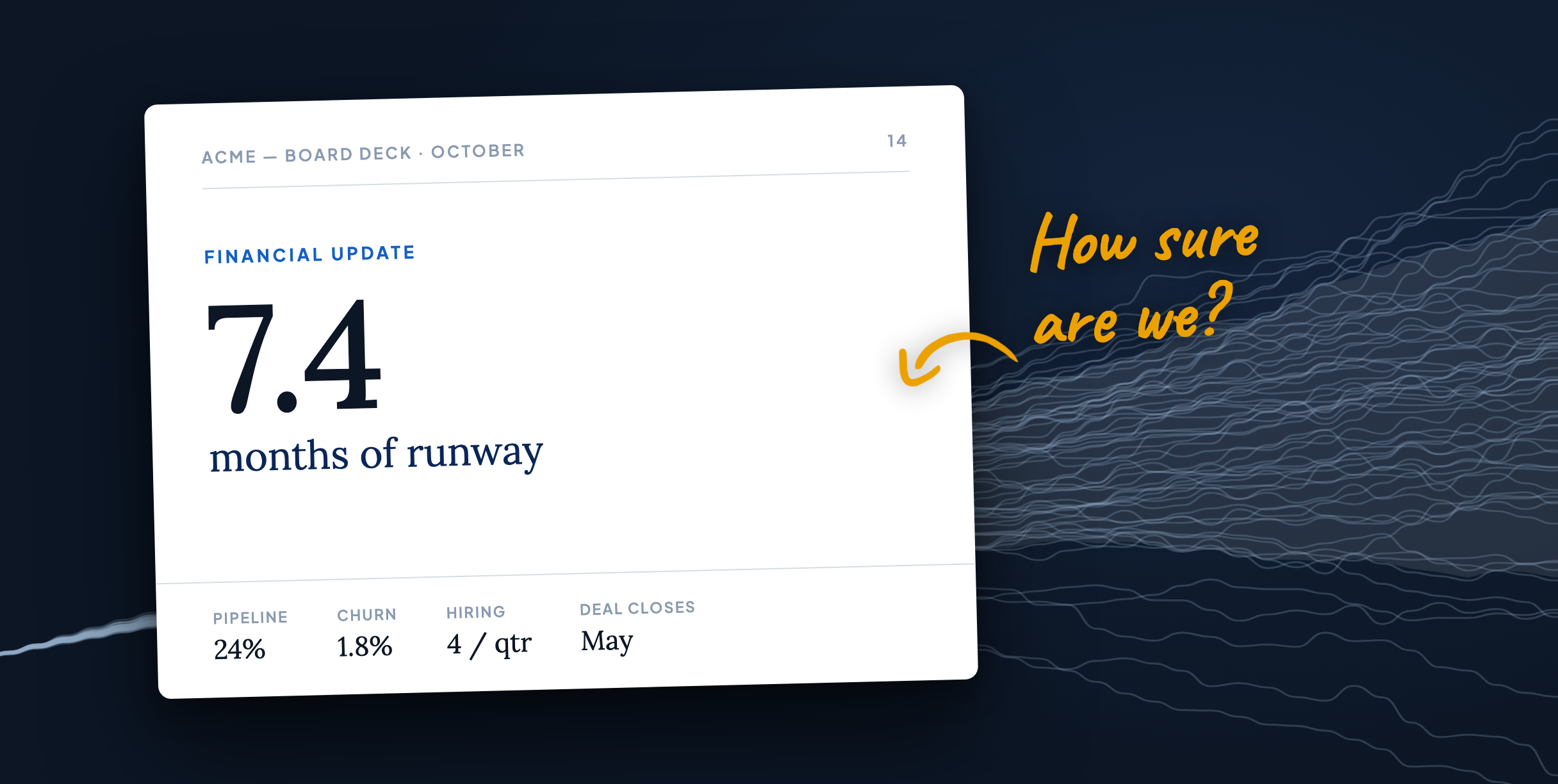
Somewhere in your deck there is a slide that says something like “7.4 months of runway.” It is a good slide. It is the product of a spreadsheet you have poured real hours into, and the number on it is, by every rule of arithmetic, correct.
Then someone on the board leans forward and asks the question that slide was never built to answer: “How sure are we?” And you do the thing every founder does. You say “fairly confident,” which is a phrase that means nothing, while your brain quietly riffles through every assumption in the model wondering which one is the loose floorboard.
You are right to wonder. One of them is.
Your spreadsheet is a confident liar
To be fair to the spreadsheet: it is not lying. It is doing exactly what you asked. You told it the enterprise deal closes in May, churn holds at 1.8%, and you hire four people a quarter. It took those numbers at their word and marched them forward month by month, arriving at 7.4 with total serenity.
The spreadsheet has never met your enterprise buyer’s procurement department. It does not know that “closes in May” is founder for “closes between April and September, we hope, please.” It cannot tell you how often the deal slips, how bad things get when it does, or whether that even matters compared to everything else that could wobble.
A forecast is one future, computed politely. The problem is not that it is wrong. The problem is that it is one.
Assumptions hold hands
Here is what makes this genuinely hard, and not just a matter of adding a pessimistic column. Your assumptions do not fail alone. They hold hands.
The enterprise deal slips a quarter. Fine — you have buffer. But the slipped deal delays the revenue that justified the two engineering hires, and you make them anyway because the roadmap says so. Now burn is up while revenue is flat. Meanwhile the fundraise you pencilled in for spring assumed a growth number the slipped deal was supposed to deliver. None of these events is dramatic on its own. Together they are how a twelve-month plan becomes a five-month plan without anyone making a single bad decision.
This is why the classic move — tweak one cell, watch the output, nod gravely — misses the point. Stress-testing assumptions one at a time is like checking each rope on a bridge while nobody stands on it. The interesting failures only show up when things move together.
So run the plan ten thousand times
There is a boring, well-established fix for this, and the only reason it is not standard practice in every startup is that it used to require a quant and a quiet week: stop feeding the model single numbers, and feed it honest ranges instead. The deal closes between April and September. Churn sits somewhere between 1.4% and 2.6%. Hiring takes as long as hiring takes.
Then run the whole plan — all the ranges at once, moving together — ten thousand times, and look at what comes out. Not a number. A shape. In 71% of those futures you stay above six months of runway. The median lands at 7.4 — hello, old friend, turns out you were the middle of a crowd all along. And in 12% of runs you drop below four months, which is the polite statistical way of saying: in roughly one future out of eight, you are writing the “difficult decisions” email.
That 12% was always in your plan. The spreadsheet just never mentioned it, because you never asked it a question it could answer that way.
The breaking point has a name
Ranges and percentages are still just weather. The useful part comes next: take the futures where the plan held, take the ones where it broke, and ask what actually separates them.
Not what you argued about in the last planning meeting — what the runs say. Line the two piles up and one assumption usually stands apart from the rest. In our running example it is the enterprise deal close date, and it is not close: it separates surviving futures from broken ones about twice as sharply as churn does, and five times as sharply as the timing of your next round — the thing everyone spent the offsite arguing about.
That is your breaking point. Not a date, not a balance: an assumption, with a name, carrying more of your plan than any other. Most founders we talk to guess wrong about which one it is. That is not an insult — it is the whole reason to run the exercise. The load-bearing assumption is a property of how your plan fits together, and intuition is famously bad at joint probability.
What you actually do on Monday
Knowing the breaking point changes surprisingly practical things. You know what to watch: not forty KPIs, one signal — the deal’s procurement milestones, tracked like weather. You know the risk attached: every week of slip moves real probability from the “fine” pile to the “below four months” pile. And you know which decision it should change: the October engineering hires are the reversible lever sitting right next to the fragile assumption. If the deal slips past a threshold, that is the decision to revisit — calmly, early, and with numbers, instead of in a panic three months later.
Compare that to the standard operating mode, which is: the deal slips, everyone feels vaguely worse, and the plan is officially revisited at the next board meeting, six weeks after the future already forked.
One future is not enough
None of this requires you to become a statistician, and it certainly does not require another dashboard. It requires taking the plan you already have, admitting out loud that its inputs are ranges rather than facts, and letting a machine do the ten thousand rehearsals no human has patience for.
Your plan has a breaking point. It has one right now, sitting in a cell that looks exactly as innocent as all the others. You can find out its name before reality does — or you can find out at the board meeting, from the person leaning forward.
